
India's curve, yet to flatten vis-a-vis countries with similar or more conservative plans to ease restrictions, still points to 'exponential growth', despite India having tested much fewer people.

In total, the Centre plans to purchase around 40.7 million tonnes of wheat from farmers this year, which is almost 19 per cent more than last year.

However, experts say that unless clear guidelines are there, it remains to be seen how many people fall within the ambit and who remains excluded.
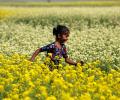
In MP, farmers say sales under new 'Sauda Patrak' method below MSP; Haryana mustard farmers wait for their turn to sell. The annual purchases of major rabi crops in North India largely wheat, mustard and also chana to some extent have been delayed as most cereal mandis were closed in the aftermath of the nationwide coronavirus lockdown.

A recent study shows that more than 100 million people are excluded from the public distribution system because the central government insists on using 2011 population figures to calculate state-wise PDS coverage, which effectively leaves out 100 million people, reports Sanjeeb Mukherjee.
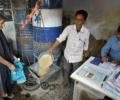
A study by eminent economists, by Jean Drze, Reetika Khera and Meghana Mungikar released few days back shows that more than 100 million people are excluded from the PDS because the central government insists on using 2011 population figures to calculate state-wise coverage under the National Food Security Act.

The stimulus package is expected anytime this week and will be aimed at the urban and rural poor; disadvantaged sections of society; MSMEs and some of the worst-affected sectors.
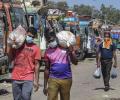
It is likely the government will divide the country into different zones during the proposed extended period of lockdown and might permit a few services to function in safe zones.
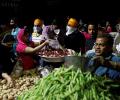
There have been several instances of traders dumping fruits and vegetables outside mandis. Or of farmers dumping produce outside their villages or feeding them to their animals.
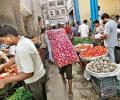
The agriculture ministry, in the last few weeks, issued guidelines and letters to states to ensure agriculture and food products reach consumers in a timely manner, while farmers don't have to come to the mandis to sell them.

IMD has said the temperature in April-June across most parts in India is expected to be 0.5-1 degrees Celsius warmer than normal. However, doctors and scientists say they haven't found any direct correlation between the speed of COVID-19 spread and warm weather.

While the meetings on Friday were preliminary discussions, it is learnt that sectors like tourism; hospitality; aviation; micro, small and medium enterprises (MSMEs); and livestock have sought deferring loan repayments and temporary tax holidays in specific cases to help them tide over the steep fall in economic activity.

The India meteorological department has stated that day temperatures are likely to be above normal by 0.5 degree Celsius, reports Sanjeeb Mukherjee.

Among manufacturing companies that went to the National Company Law Tribunal (NCLT), chemicals and metal firms witnessed more resolutions while companies in the labour intensive (employment friendly) leather and textile sectors mostly get liquidated, reports Abhishek Waghmare.
India is expected to harvest 291.95 mt of foodgrain in 2019-20

The size of Delhi's Budget is close to Rs 55,000 crore, or about 6 per cent of its gross state domestic product (GSDP). What set the state apart is that in the last decade, its fiscal deficit hardly crossed 1 per cent of GSDP, while many other states grappled to contain it within 3 per cent. This was largely possible due to the revenue surplus position, reports Abhishek Waghmare.

The impact of economic slump was visible in the Budget's fine print, as this step-by-step explanation show how the Budget math was worked out, reports Abhishek Waghmare.
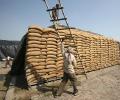
This is the highest in the past five years and almost 24 per cent more than last year.

Finance Minister Nirmala Sitharaman has brought down the budgetary allocation for the fertiliser subsidy for FY21 to Rs 71,309 crore, from the RE of Rs 79,998 crore for FY20, while increasing food subsidy to FCI through "ways and means advance" to Rs 50,000 crore for FY21, from Rs 36,000 crore in RE for FY20, and under the National Food Security Act (NFSA) to Rs 77,982 crore, from Rs 75,000 crore.

In comparison to other asset classes, globally, gold rallied significantly after many years to deliver 18.4 per cent returns in 2019.
 © 2025 Rediff.com - Investor Information - Advertise with us - Disclaimer - Privacy Policy - Sitemap - Feedback - About us - Terms of use - Grievances